
COMMUNITY SUPPORTED HEALTHCARE
Making an Informed Decision About Your Public Hospital District
Kiowa County Hospital District and its Board of Directors are presenting a question on the 2024 General Election Ballot, which asks for an increased operating levy. The amount the District receives from Mill Levy has remained the same since 1994.
If approved, the increase will not directly impact voters in Kiowa County who do not own property or pay property taxes. However, it will help provide crucial financial support for operating Weisbrod Health, including the hospital, clinic and outpatient services essential to all residents of Kiowa County.
The information on this website provides facts and details that aim to help our community make an informed decision about the levy increase ballot measure. If you have a question that needs addressing and don't find it here, please use the Submit Question feature above.
1 Mill = $1.00
per $1,000 dollars of assessed value
THE MILL LEVY LIFT
What is a Mill Levy?
A Mill Levy is the “tax rate” that is applied to the assessed value of the property. One mill is one dollar per $1,000 dollars of assessed value. KCHD is a special district and has their own Mill Levy, and all the funds generated from that specific Mill Levy come directly to the hospital.
KIOWA COUNTY HEALTH DISTRICT'S (DBA WEISBROD HEALTH)
Critical Access Hospital Funding Sources
Medicare Reimbursement
Medicare helps cover readiness costs based on annual reports of operational costs and patient population.
State & Federal Funding
Various state and federal programs provide inconsistent and time-limited funding for different needs.
District Taxes
Mill Levy tax funds from county landowners support operations, equipment, and facility maintenance.
Patient Revenue
For every $1.00 billed for patient care, Weisbrod Health receives $0.33 from Medicaid. Generally, we receive less from payers (insurers) than the cost of the care we provide.
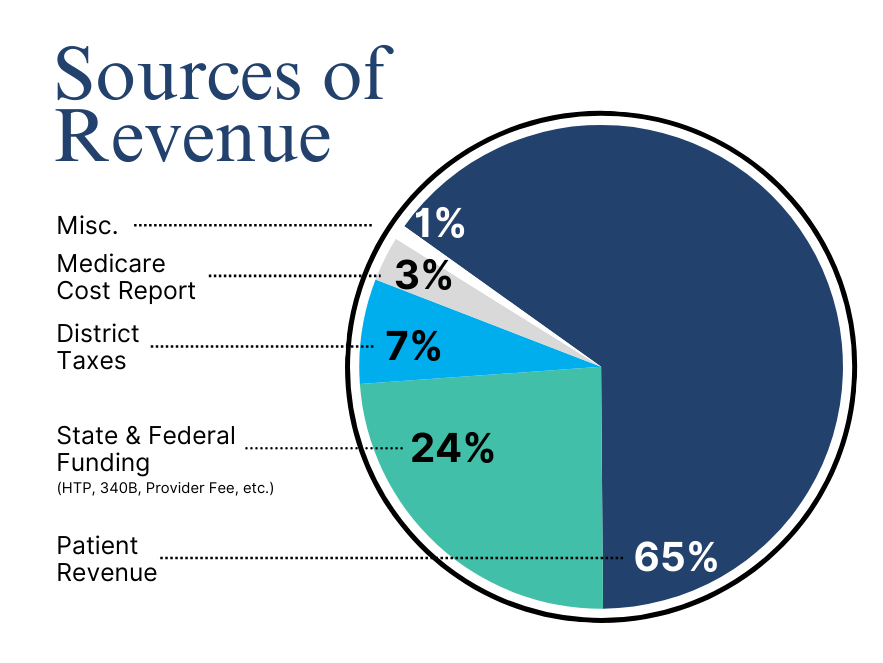
It takes several revenue streams to make a Critical Access Hospital (CAH) whole, one of which is money generated from local taxpayers via the Mill Levy.
Inflation and its Impact on the Hospital District
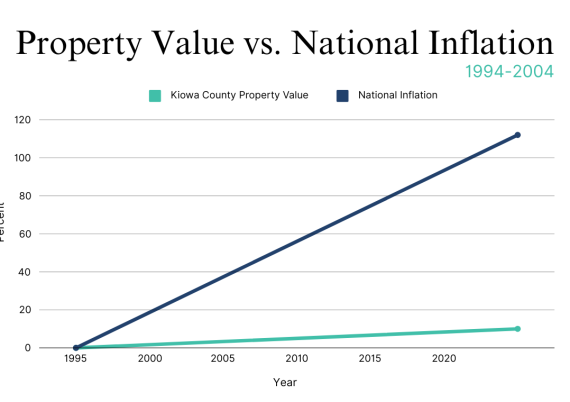
Inflation at the national level has continued to rise, and Kiowa County property values have remained relatively flat (see comparison graph). As the Hospital District’s expenses have continued to rise (salaries/minimum wage & supplies), Mill Levy funding has also been relatively flat with a modest 10.8% change over the last 33 years.
As a result, the Hospital District has been significantly underfunded for an extended period leaving us at risk of closure, thus driving the need for a Mill Levy increase in 2024.
Facing the Reality of Inflation's Impact
- General Inflation from 1994 to 2024, per the Bureau of Labor Statistics consumer price index reflects an inflation rate of 112%.
- Kiowa County Property Value Inflation from 1994 to 2024, per the Kiowa County Assessor’s Office, reflects an inflation rate of just 10.34%.
Solutions to a Long-Standing Problem
- To get the Mill Levy to the same purchasing power in 1994 we would have to increase the Mill Levy from 13.23 to 28.05. The Kiowa County Hospital District Executive Team and Board of Directors feel that this is an unreasonable ask of the residents of Kiowa County.
- To adjust the Mill Levy conservatively but achieve a 3% operating margin, we need to increase the Mill Levy from 13.23 to 19.45 Mills. The Kiowa County Hospital District Executive Team and Board of Directors feel that this is a fair request to help ensure residents of Kiowa County have access to healthcare services in Kiowa County.
Mill Levy Math Facts
Impact to the Taxpayer
$13.23
1994 the Mill Levy was set at 13.23 mills per year for every $1,000 of assessed property.
$6.22
Requesting an increase of 6.22 mills for every $1,000 of assessed property value amounts to an increase of $6.22 or 2¢ per day.
$19.45
The proposed Mill Levy lift will provide an additional 6.22 mills per year for every $1,000 of assessed property, increasing the amount it receives from $13.23 per to $19.45.
$0.02 per day...
Will continue to provide critically needed funds to support health care services, including purchasing medical equipment, maintaining facilities, and staffing and recruitment needs.
Keep reading to understand how to calculate the impact this will have on you.
Impact to the Hospital if the Mill Levy Increase is Passed

Protect Local Healthcare
The additional tax revenue would support the hospital in covering operating expenses and achieve a 3% operating margin for continued investment in the hospital’s aging facilities and future operations (new equipment purchases, etc.).
Demonstrate Our Creditworthiness
Prove to the USDA Office that this community is invested in the Hospital District, which is a requirement to secure funding through USDA.
Determine Future Grant Funding
Prove to Grantmakers that the community is invested in the Hospital District, which is a requirement to secure additional grant funding.
THE IMPACT ON PATIENTS
Bringing Patients Peace of Mind
Our Story Could Have Had a Different Ending
Loraine and Roger Saffer have both experienced health issues that, were it not for having Weisbrod in the community, Loraine shared, “could have turned out differently. It’s the lifeblood of the community. Whether you or a loved one is experiencing a heart attack or suffered a stroke, having a hospital nearby makes all the difference.”
Giving Back
Community Impact & Investments
$
0
M
KCHD creates over $22 Million in direct and indirect economic impact to the community.
0
We employee over 100 employees, the largest in the county.
$
0
M
Direct Hospital Payroll and Benefits contributes $5 Million annually.
$
0
M
Indirect Hospital Payroll and Benefits contributes $4.5 Million annually.
Keep reading to learn more about the impact of Kiowa County Hospital District on our community.
You've got questions
We've Got Answers
Critical Access Hospital is a designation given to eligible rural hospitals by the Centers for Medicare & Medicaid Services (CMS). Congress created the CAH designation through the Balanced Budget Act of 1997 (Public Law 105-33) in response to over 400 rural hospital closures during the 1980s and early 1990s. Since its creation, Congress has amended the CAH designation and related program requirements several times through additional legislation.
The CAH designation is designed to reduce the financial vulnerability of rural hospitals and improve access to healthcare by keeping essential services in rural communities. To accomplish this goal, CAHs receive certain benefits, such as cost-based reimbursement for Medicare services.
Eligible hospitals must meet the following conditions to obtain CAH designation:
- Have 25 or fewer acute care inpatient beds
- Be located more than 35 miles from another hospital (exceptions may apply)
- Maintain an annual average length of stay of 96 hours or less for acute care patients
- Provide 24/7 emergency care services
Weisbrod Health offers a range of services and Hospital District leaders are committed to responsibly expanding services and facilities when financially feasible. The core services we provide today include:
- Inpatient Hospital Care including Acute & Skilled Swing Beds
- Rehabilitation Therapy
- Emergency Medicine, including Observation Room Services
- Extended Care Services
- Primary Care for people of all ages in the Rural Health Clinic
- Cardiology Specialty Services
- Chiropractor Services
In addition to the above services, Weisbrod Health has been actively recruiting healthcare professionals and staff to ensure more access to high-quality primary care and proactively applying for and receiving vitally important grant dollars to fund essential equipment purchases, programs, and other initiatives that benefit patient care, ensure workplace safety, and positively impact County residents.
Current initiatives include:
- May 2024, we welcomed Erik Ritch, MD to our Medical Staff, which allowed us to move away from using Travel/Locums providers.
- August 2024, we launched a new Medical Record System to help improve patient safety and data collection.
- Fall 2024, we start our grant-funded Quality Improvement and Quality Assurance Initiative. ($20,000)
- Fall 2024, we start our grant-funded Strategic Operational and Financial Assessment with the National Rural Health Association. ($50,000)
- In September 2024, we are launching a grant-funded Mobile Clinic offering Primary Care and Dental Services. ($168,000)
- In early Spring of 2025, we plan to break ground on a grant-funded New Clinic Building that will allow us to expand our primary, specialty, and dental care services. ($1.9 Million)
Hospital District leaders understand that to deliver high-quality healthcare and ensure Weisbrod’s competitiveness, we must have a functional facility that meets state environment of care requirements.
A growing concern for the District is its aging facilities and doing all possible with the means we have to maintain them to standard without significant investments in upgrades to areas that have already exceeded or are near the end of their life expectancy.
We are actively seeking grant funding opportunities for each of the following initiatives. However, we recognize that we won’t be able to cover the entire expense using grant funds. Therefore, it’s crucial that we position ourselves to qualify for financing through USDA.
In our long-term planning, and when financially feasible, the District has prioritized the following facilities and operations projects.
- Convert the existing clinic building into a more functional space for our rehab therapy department.
- Update aging systems within the hospital at or near their life expectancy (mechanical, electrical, etc.)
- Expand hospital facility, including a new wing for extended care services, pending USDA financing.
The short answer is that the hospital’s operating margins are slim, but we are actively implementing strategies to ensure its sustainability, and it is not in immediate danger of closing.
The more complex answer is that, unfortunately, and due to many circumstances beyond our control, including continued lack of local investments and underfunded reimbursement rates from payers (both commercial insurance and the Centers for Medicare & Medicaid Services (CMS)), Weisbrod, like many other CAHs in the state and country, are increasingly vulnerable.
Additionally, 2023 was a positive year for our financials, and through careful strategic planning, we have made several key changes this past year to help reduce expenses wherever possible. That said, the Board and organization leaders know that operating margins are not large enough, and a significant need remains for reinvestment to sustain our current facility. These funds must come from an increase in the mill levy allocated to the Kiowa County Hospital District.
Kiowa County is designated as a Health Professions Shortage Area (HPSA), meaning there is a shortage of primary care and mental health services. Once the mobile clinic is operational, we can address the dental care gap in our community. To meet the healthcare needs of our community, we must work diligently to recruit health professionals, but this cannot be done without ensuring that we have the space for new providers to practice and to accommodate patients in our waiting area and exam rooms. Our current clinic does not have space to support the providers we have, let alone add providers or accommodate additional visiting specialists.
In addition to our commitment to meeting the health needs of our community, we must also generate revenue to improve the District’s finances. This is done through revenue generated through patient visits.
As mentioned earlier, the new clinic space is ALREADY funded through a grant that the District applied for and received, at no additional expense to the taxpayers of Kiowa County for the build. This new space not only addresses our healthcare needs but also serves as a sound investment, generating revenue through patient visits. The same is true for the mobile clinic, which was made possible through a grant, ensuring no extra financial burden on our taxpayers for the acquisition.
The Mill Levy is the “tax rate” that is applied to the assessed value of the property. One mill is one dollar per $1,000 dollars of assessed value. KCHD is a special district and has their own Mill Levy, and all the funds generated from that specific Mill Levy come directly to the hospital.
A Mill Levy Lift is another way of describing an ask of taxpayers to increase the amount of tax the the Hospital District receives. The Kiowa County Hospital District and its Board of Directors is pursuing a Mill Levy Lift this year, asking voters to make an informed decision on the matter that will appear on the 2024 General Election Ballot.
It is important to note that if approved, the Mill Levy Lift will not have a direct impact on voters in Kiowa County who do not own property or pay property taxes.
In 1991 the Kiowa County Hospital District Mill Levy was lifted from 3.26 to 14.56 Mills.
In 1994 De-Brucing passed. “Debrucing” refers to the act of removing the revenue limits imposed by Colorado’s Taxpayer Bill of Rights (TABOR). When a municipality or other government entity “debruces,” it means that voters have approved a measure to allow that entity to retain and use revenue that would otherwise have to be refunded under TABOR limits. The Mill Levy was set at 13.23 in 1994 and has remained there since.
Impact to the Taxpayer:
- Current Amount $13.23 per year for every $1,000 of assessed property value.
- Increase of $6.22 per year for every $1,000 of assessed property value.
- Less than 2 cents per day for every $1,000 of assessed property value.
- Total of $19.45 per year for every $1,000 of assessed property value.
How to calculate the impact this will have on YOU:
> Get Instant Results, Use the Mill Levy Calculator Below
Step by Step Instructions on how to calculate the tax increase. | Example | |
A | Find the TOTAL VALUE on your recent tax slip. | = 6020 |
B | Divide that by 1,000 | = 6.02 |
C | Multiply the Line B number by 19.45 (which is the new Mill Levy Rate) | = $117.09 |
D | To compare, multiply the same number in Line B by the current Mill Levy rate of 13.23. | = $79.64 |
E | Subtract line D from line C. This is how much your taxes would increase if passed. | = $37.45 |
The Tax Slip shows two-line items that have Hospital in the description:
- Public Hospital Fund – Kiowa County Commissioners manage the allocation of these funds through their annual budget process.
- Funds generated support the Kiowa County Ambulance Service.
- History of these funds: prior to 2021 the Ambulance received 5 Mills, in 2021 the County Commissioners decreased the amount the Ambulance Service receives to 3 Mills.
- The Ambulance Service has been operating at a loss since that change in 2021, putting additional financial pressure on the Hospital District to fill the gap financially to keep this vital service available to the residents of Kiowa County.
- Kiowa County Hospital – 13.230 Mills, which the Hospital District receives directly.
As a special hospital district and a designated critical access hospital serving Kiowa County, operating and maintaining our facilities takes several revenue streams, including money generated from local taxpayers. The sources of funding used by KCHD to maintain its services and facilities are as follows:
- Medicare Reimbursement through our cost reporting efforts.
- CMS does their part to cover our cost of readiness to provide services for their portion. Every year we send them our cost report which details what it costs us to operate, minus our patient revenue (essentially, our loss). They look to see what percent of our patient population has Medicare and then they send us money to help off-set our losses for their share.
- State & Federal Funding:
- HCPF and other State/Federal programs offer some funding support for various things, these are not consistent and usually age out.
- County Taxes:
- Mill Levy Tax. These are funds that come from county landowners to support hospital operations, equipment investments and maintenance of the facilities.
- Patient Revenue:
- This is the money that KCHD collects from payers for the services provided. In all situations, what we receive from payers is less than what we charge for services.
- For every $1.00 we bill to CMS we receive back $0.33
In addition to creating over $22 Million in direct and indirect economic impact to the community KCHD supports the community in several vital areas, including:
- Employing over 100 people making the Hospital District the largest employer in the county
- Direct Hospital Payroll and Benefits contributes $5 Million annually
- Indirect Hospital Payroll and Benefits contributes $4.5 Million annually
- Direct Hospital Expenditures, $5.7 Million annually
- Indirect Hospital Expenditures, $7.6 Million annually
The Hospital District believes it’s essential to explain that it’s not just a question of if we want to ensure access to healthcare in Kiowa County. In the larger picture, it’s a question as to whether we want to see Kiowa County continue to thrive in the future or not.
Multiple studies have shown that when a small rural hospital like ours closes, the community suffers from other losses, including a decline in school enrollment and businesses, a reduction in per-capita income, and an increase in unemployment. Certainly, Kiowa County would not be spared from experiencing these impacts should Weisbrod and the Hospital Districts Rural Health Clinic be forced to close their doors.
Ballot Question 6A
Kiowa County Hospital District
Levy Lid Lift for Health Care Services
Shall Kiowa County Hospital District’s taxes be increased by the imposition of an increased operating levy not to exceed 19.54 mills beginning in tax collection year 2025 and continuing thereafter upon the then current assessed valuation of all property located within Kiowa County Hospital District in order to increase or improve levels of public services, including but not limited to, funding improvements to Kiowa County Hospital District’s aging facilities and investing in future operations to support the Kiowa County Hospital District community.
And shall the Kiowa County Hospital District be entitled to collect, retain, and spend those revenues in addition to any other taxes, fees, or other revenues of Kiowa County Hospital District as a voter approved revenue change and exception to any spending or revenue restrictions or other limits contained in Article X, Section 20 of the Colorado constitution; and shall all of the terms and conditions herein be perpetual in duration until amended?
Should this proposition be approved?
- Approved
- Rejected

Kiowa County Hospital District dba Weisbrod Health is a community driven health care entity. We are continuously looking to enhance and expand health care services to the friends and families of Kiowa County and our neighboring communities.
Quick Links
© 2024 Kiowa County Health District